
‘Aggregate’ was held at the now defunct Bank Gallery, Durban, in 2008, and was a small survey exhibition with just two new works, serving too as a launch for my self-published book of the same name.
The two new pieces, Sift and Aggregate, responded to the saturated hues and balmy climate of KwaZulu-Natal. The former, a large woven screen-like work, functioned as a permeable barrier between exterior and interior in the manner of a brise-soleil, while Aggregate was made from aromatic camphor wood, the material I first used when learning to carve in nearby Pietermaritzburg.
Reef, made from hundreds of carefully incised and assembled polystyrene cups, was first shown in 2001, while Knurl is made from finely carved polystyrene punnets, and was initially shown in 2002. Weft, so far my sole venture into videography, was initially produced in Durban with the assistance of artist and friend Greg Streak in 2003 and was re-made in 2007 with musician, artist and friend Brendon Bussy.
Photos by Andrew Griffin. Read a review here.

Installation view with Sift in foreground and Knurl behind.
Sift was woven from polypropylene strapping which I’d collected from the light industrial building where I worked. I’d encountered baskets woven from this material in South Africa, but much more in Mauritius where I worked briefly for an NGO in 2000. The work served as a screen at the entrance to the gallery and was inspired in part by the brick brise soleils very common in Durban apartment blocks, and indeed in sub-tropical and tropical cities all over the world, where they serve to regulate temperature. I lent the work an illusion of depth by weaving a pattern into the structure. In retrospect, I had probably seen some of Sol LeWitt’s wall-based works as a student. These would become more important to me later.

Installation view with Sift in foreground and Aggregate behind

Aggregate, 2008, Camphor wood veneer
I laminated large sheets of Camphor wood and cut through these in a carefully determined fashion. Each layer had larger hexagons than the layer immediately beneath cut out. Occasionally holes of different sizes line up perfectly and present clear passage through the construction. In this way, the work investigates registration (in space) in much the same way that Weft explores registration in time in the time-based medium of video. I was taught to work in wood by artist Carl Roberts in nearby Pietermaritzburg, and the first wood I carved was Camphor. My use of it here acknowledges that.
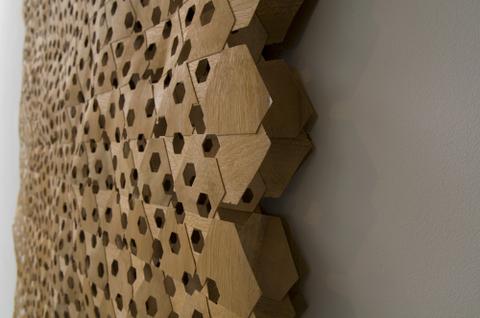
Aggregate, 2008 (detail)

Reef, 2008, polystyrene cups
This was a second version of the work I’d first presented on my show ‘Houding’ in 2001. Back then, I did some part-time teaching in various Western Cape tertiary institutions, This didn’t involve much admin work, so often I had spare time, and students dumped a good amount of polystyrene coffee cups from their cafeterias. I began collecting these and carving tracery into them using a tool cobbled together from an NT Cutter and safety razor blades.
The work reflects on permanence – although we think of polystyrene as cheap and disposable, it is remarkably persistent, which is why it’s problematic. I had explored this in greater depth earlier.

Weft, 2007, looped DVD, with original footage from Bruce Brown’s Endless Summer, produced by Brendon Bussy
Brown’s 1966 Endless Summer was shot all over the world and arguably created the template for most subsequent surf movies – a search for the perfect wave. A passage of this film shot at Cape St Francis (subsequently named ‘Bruce’s Beauties’) is presented right way round and reversed, meeting in the middle of the screen. The two slip in and out of sync, regularly lining up perfectly, briefly creating a symmetrical image. We’re in Durban here – it would be remiss of me not to reference surfing! That would become a central concern of mine later.
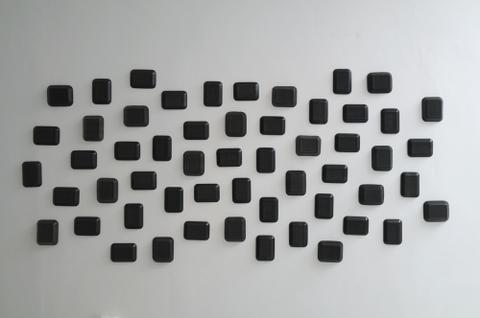
Knurl, 2002, polystyrene punnets, dimensions variable
As I did with polystyrene cups above, I collected these over time. Into their surfaces I carved a delicate diamond knurl, a design that interested me as it typically occurred in tools and other surfaces which required resistance to slippage and wear-and-tear. And it aged beautifully. There was an inherent contradiction in this pattern emerging on disposable polystyrene items, which were both fragile and long-living. I had explored this in a series of bronzes I produced for my show ‘Houding’ a few years earlier. I showed this work in a few different configurations.

Knurl (detail)
 Paul Edmunds